Tokenization for Banks: The Complete 2026 Guide

Tokenization for banks: key takeaways
Tokenization for banks, defined: Tokenization for banks is the issuance of deposits, securities, funds or loans as digital tokens on a programmable ledger. The bank keeps the legal liability; the token adds 24/7 transfer, atomic settlement and coded rules. In 2026 it is live at JPMorgan, Citi, HSBC, BNY and Société Générale.
Tokenization has moved from pilot to production in banking. Distributed tokenized real-world assets (RWAs) on public chains reached about $39 billion in October 2026 according to rwa.xyz ($39.02 billion on 9 October, per KuCoin), up from roughly $6 billion at the start of 2025. A further ~$352 billion is “represented” on-chain, mostly on permissioned ledgers where much bank tokenization lives. Banks now run live deposit-token rails: JPMorgan’s Kinexys processes billions of dollars a day, and JPMD has been live on Coinbase’s Base network since late 2025.
The question for a bank in 2026 is no longer whether to tokenize but what, on which network, and with whom. This guide covers:
- what tokenization is and how a bank token works end to end
- the business case: settlement, liquidity, cost and programmability
- which assets banks are tokenizing first, and what leading banks have shipped
- tokenized deposits versus stablecoins versus CBDCs
- the reference technology architecture and the regulatory map
- risks, and a phased roadmap a bank can follow
| Headline figure | Value | Source |
|---|---|---|
| Tokenized RWAs on-chain (ex-stablecoins), Oct 2026 | ~$39.0B distributed (9 Oct 2026), plus ~$352B represented | rwa.xyz via KuCoin |
| Kinexys (JPMorgan) daily volume | $5B+ per day (Apr 2026); JPMorgan has since cited $7B+ | Crypto Briefing, The Defiant |
| Tokenized deposit flows possible by 2030 | $100–140 trillion a year | Citi Institute |
| Tokenized RWA forecast, 2030 | up to $16 trillion | BCG via Merehead |
What is tokenization in banking?
Tokenization is recording ownership of an asset, or a claim on it, as a digital token on a programmable shared ledger (a blockchain or other distributed ledger). The token carries the asset’s rights and can be moved, pledged or settled under coded rules. The legal claim stays with the issuer, the bank, fund or custodian; the token is a new record format for that claim.
The word means two different things in banking, and it helps to separate them early.
| Data (payment) tokenization | Asset tokenization | |
|---|---|---|
| What it does | Replaces a sensitive value, such as a card number, with a random surrogate | Represents an asset or liability as a transferable token on a ledger |
| Purpose | Security and PCI-DSS compliance | Settlement, liquidity, programmability, new distribution |
| Ledger | Bank’s or network’s token vault | Permissioned or public blockchain |
| Examples | Apple Pay, Visa Token Service, Mastercard MDES | Deposit tokens, tokenized bonds, tokenized money market funds |
| Does the token have value? | No, it is a pointer | Yes, it is the asset or a claim on it |
This guide is about asset tokenization: putting deposits, securities, funds and loans on-chain.
How does bank tokenization work, step by step?
- Originate. The bank holds or creates the underlying asset: a client deposit, a bond, a fund share, a loan.
- Structure. Legal teams define what the token represents, who may hold it, and how it is redeemed. For securities this is often a digital-native issue or a tokenized share class.
- Mint. A smart contract issues tokens 1:1 against the asset. The bank’s ledger and the chain are reconciled.
- Control. Permissioning (whitelists, KYC-bound wallets), transfer rules and freeze or claw-back functions are coded into the token.
- Transfer and settle. Tokens move between wallets in seconds, 24/7. Delivery-versus-payment (DvP) swaps a security token against a cash token atomically: both legs settle or neither does.
- Service. Coupons, interest, dividends and corporate actions are paid by the contract.
- Redeem and burn. The holder redeems for the underlying; the bank burns the token and settles off-chain.
Why are banks adopting tokenization?
Banks tokenize to settle faster, free up trapped liquidity and collateral, cut reconciliation cost, and keep clients who now expect 24/7 on-chain money. Each benefit maps to a specific pain in today’s plumbing.
| Benefit | Today’s pain | What tokenization changes | Evidence |
|---|---|---|---|
| Faster settlement | T+1 to T+5 for securities; cut-off times and weekends for cash | Near-instant, atomic DvP, 24/7 | Hong Kong’s HK$6B-equivalent digital green bond (Feb 2024), issued on HSBC Orion, settled T+1 vs a typical T+5 (HSBC) |
| Liquidity and treasury | Cash trapped across entities and time zones; pre-funding of nostro accounts | Intraday, cross-entity sweeps around the clock | JPMD offers 24/7, near-instant settlement on Base (The Block) |
| Collateral mobility | Collateral locked in silos; slow margin calls | Tokenized collateral moves in minutes, intraday repo | Canton cross-border intraday repo using tokenized gilts (CryptoSlate) |
| Lower operating cost | Multiple ledgers reconciled by hand; failed trades | One shared record; fewer breaks and intermediaries | Agorá bundles messaging, compliance and settlement in one step (BIS findings) |
| Cross-border payments | Chains of correspondent banks; days to settle | Shared ledger settles payment and FX together | Agorá’s July 2026 live test: 30 transactions worth about CHF 800,000 (~$1M), settling in about 80 seconds on average (Blockhead) |
| Programmability | Conditional payments need manual checks | Smart-contract escrow, auto-coupons, pay-on-delivery | KPMG cites conditional payments as a proven deposit-token use (Taurus) |
| New revenue and distribution | Minimum ticket sizes; limited investor reach | Fractional units, new digital channels, custody and issuance fees | BNY + Goldman tokenized MMF share classes (Canton) |
| Client retention | Corporates and fintechs moving to stablecoins | Bank money stays on balance sheet in on-chain form | Tokenized deposits keep dollars inside the banking system (KuCoin/Bitcoin.com) |
The defensive argument matters as much as the offensive one. If corporate treasurers can hold and move dollars on-chain, a bank without an on-chain deposit product risks losing balances to stablecoin issuers.
What assets are banks tokenizing?
Banks start with cash and short-dated, highly liquid instruments, because those are easiest to value, redeem and regulate. Less liquid assets follow once secondary markets and legal templates mature.
| Asset class | Typical bank role | Maturity (2026) | Live examples |
|---|---|---|---|
| Deposits (deposit tokens) | Issuer | Production | JPMorgan JPMD, Citi Token Services, HSBC Tokenised Deposit Service, BNY tokenized deposits |
| Money market funds | Custodian, transfer agent, distributor | Production | BNY + Goldman (LiquidityDirect / GS DAP), JPMorgan MONY, BlackRock BUIDL, Franklin BENJI |
| Bonds and notes | Arranger, platform operator, custodian | Early production | HSBC Orion digital bonds, Goldman GS DAP, SG-FORGE green bonds on Canton |
| Repo and collateral | Counterparty, collateral agent | Early production | Broadridge DLR intraday repo, Canton tokenized gilt repo, SG-FORGE repo on Canton |
| Stablecoins (bank-issued) | Issuer via subsidiary | Early production | SG-FORGE EURCV and USDCV |
| Trade finance | Lender, platform member | Pilot | Tokenized invoices and supply-chain settlement under Project Guardian |
| Private credit and loans | Originator, servicer | Pilot to early production | Tokenized credit funds (e.g. Apollo via Guardian) |
| Real estate and alternatives | Custodian, distributor | Pilot | Fractional property and fund interests, mostly via fintech partners |
| Precious metals | Custodian | Production (non-bank led) | Tokenized gold products |
Maturity reflects the author’s reading of public deployments as of November 2026.
How big is the tokenized asset market in 2026?
The tokenized real-world asset market reached about $39 billion in distributed value in October 2026 ($39.02 billion on 9 October, per rwa.xyz). That is roughly six times its January 2025 level and about 81% above the ~$21.5 billion at the start of 2026 (KuCoin, Benzinga). Tokenized US Treasuries are the largest category at about $14.7 billion in late September 2026, followed by private credit ($7.9 billion) and commodities ($5.2 billion) (4IRE Labs, citing rwa.xyz).
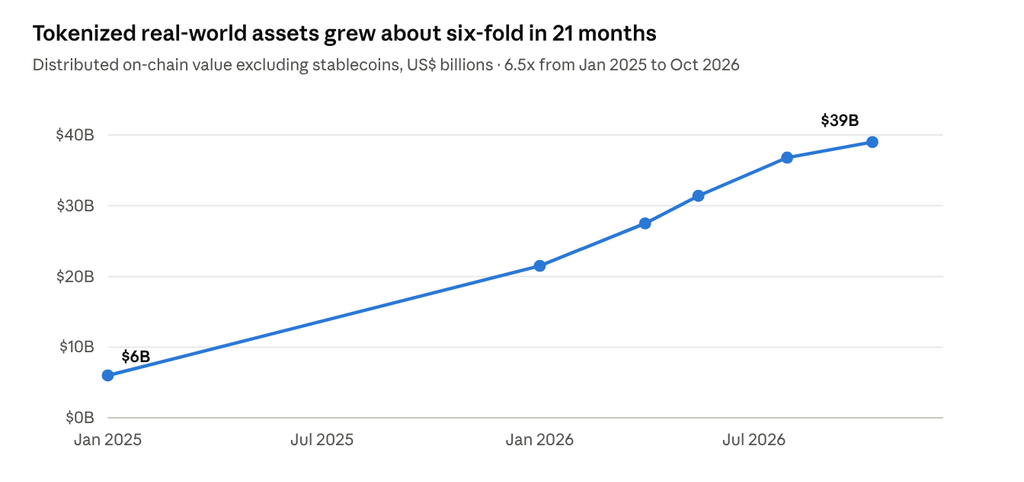
Trackers disagree because they count different things. CoinGecko put the market at $19.3 billion at the end of March 2026, while rwa.xyz, which includes permissioned registries, measured about $27.5 billion (Merehead). Always quote the source and date with any market-size figure.
rwa.xyz separates “distributed” assets (transferable on public chains) from “represented” assets (recorded on-chain, mostly on permissioned ledgers). Represented value was about $352 billion on 9 October 2026, and much bank tokenization sits there. The methodology changed during 2025, so older headline totals, such as $34.1 billion in October 2025 (Bitcoin.com), are not comparable with the figures charted here. Other trackers count differently: Token Terminal put tokenized assets at about $46 billion in late October 2026 (Crypto Briefing).
| Long-range forecast | Figure | Horizon |
|---|---|---|
| Tokenized bank deposit flows (Citi Institute) | $100–140 trillion a year | 2030 |
| Tokenized illiquid assets (BCG and ADDX, 2022) | up to $16 trillion | 2030 |
| Tokenized assets incl. stablecoins and tokenized deposits (BCG and Ripple, 2025) | $18.9 trillion | 2033 |
| Tokenized assets (Standard Chartered) | up to $30 trillion | 2034 |
Sources: Citi Institute, Ripple and BCG, Ledger Insights on the 2022 BCG forecast, Merehead. Forecasts are scenarios, not measurements, and use different scopes.
Which banks are using tokenization? 2026 case studies
Most of the largest global banks now run tokenization in production or live testing, led by JPMorgan’s Kinexys. Most started with deposit tokens or tokenized money market funds, then moved to public or shared networks such as Base and Canton.
| Bank | Platform | What is live | Latest milestone |
|---|---|---|---|
| JPMorgan | Kinexys (formerly JPM Coin / Onyx) | Deposit token JPMD on Base; tokenized MMF (MONY); over $5B average daily volume (Apr 2026) | JPMD live on Base (Nov 2025); expanding to Canton in 2026 |
| Citi | Citi Token Services | Tokenized deposits for institutional liquidity and cross-border payments | Integrated with 24/7 USD clearing (Sep 2025) |
| HSBC | Orion; Tokenised Deposit Service | Digital bonds; tokenized deposits for corporates | Deposit service expanded to the US (Apr 2026); Orion first to pass Gate 2 of the Bank of England Digital Securities Sandbox (13 Jul 2026) |
| BNY | LiquidityDirect + GS DAP | Tokenized MMF share classes; tokenized deposit service | Tokenized deposits for institutional clients (Jan 2026) |
| Goldman Sachs | GS DAP on Canton | Ledger for MMF ownership; digital bond issuance | Mirrored MMF tokenization with BNY, BlackRock and Fidelity (Jul 2025) |
| Société Générale | SG-FORGE | MiCA stablecoins EURCV and USDCV; tokenized green bonds | Announced EURCV and USDCV deployment on Canton for collateral and repo (May 2026) |
| Deutsche Bank | Project Agorá participant | Real-value tokenized cross-border payments | €10,000 live test payment between Lloyds and CaixaBank (Jul 2026) |
| DBS | DBS Token Services | Tokenized deposits; interoperability with Kinexys | Cross-network deposit-token framework with JPMorgan (Nov 2025) |
Single-bank tokens do not interoperate, so banks are joining shared networks. JPMorgan, Bank of America, Citi and Wells Fargo plan a tokenized deposit network run by The Clearing House, launching as soon as the first half of 2027 (The Block). In the UK, Barclays, Lloyds, NatWest, HSBC, Nationwide and Santander ran a regulated liability network pilot with real consumer transactions through mid-2026 (Cosmos).
Across borders, the BIS-led Project Agorá brings together eight central banks and more than 40 financial institutions. In July 2026 real-value tests, 28 institutions and central banks completed 30 transactions worth about CHF 800,000 (~$1 million) across six currencies, with settlement averaging about 80 seconds (Blockhead).
Tokenized deposits vs stablecoins vs CBDCs: what is the difference?
A tokenized deposit is a bank’s own deposit liability in token form; a stablecoin is a claim on a reserve pool held by a separate issuer; a CBDC is a direct liability of the central bank. In the US, the GENIUS Act excludes tokenized deposits from the definition of a payment stablecoin (Crypto Briefing), and the FDIC has proposed to confirm that deposits in tokenized form remain deposits (FDIC).
| Feature | Tokenized deposit | Payment stablecoin | Wholesale CBDC |
|---|---|---|---|
| Issuer | Licensed commercial bank | Licensed stablecoin issuer (bank subsidiary or non-bank) | Central bank |
| Legal nature | Deposit liability of the bank | Claim on segregated reserve assets | Central bank money |
| Deposit insurance | Treated as a deposit (US; FDIC 2026 proposal) | No | Not applicable |
| Pays interest | Can pay interest | US issuers barred from paying yield | Usually no |
| Backing | Bank balance sheet, capital and liquidity rules | 1:1 reserves in cash, T-bills, repo | Sovereign |
| Fractional reserve lending | Yes, funds stay in credit creation | No | No |
| Typical users | Institutional and corporate clients | Retail, crypto markets, fintechs, cross-border | Banks and FMIs only |
| Network | Permissioned or permissioned-on-public | Mostly public chains | Central-bank ledgers |
| Examples | JPMD, Citi Token Services, HSBC TDS | USDC, EURCV, USDCV | Project Agorá reserves, mBridge, HKMA Ensemble |
The interest point comes from the OCC’s final GENIUS Act rule: the ban on stablecoin yield does not reach interest on deposits, including tokenized deposits (Winston & Taylor). That gives banks a structural edge for institutional cash. The BIS argues that tokenized deposits settling in central bank money also preserve the “singleness of money” (Cointelegraph).
What technology do banks need for tokenization?
A bank needs six layers: client channels, bank applications, a token (smart contract) layer, custody, ledger and node infrastructure, and interoperability, all reconciled to the core banking ledger. Only the token layer is truly new; the rest extends systems banks already run.
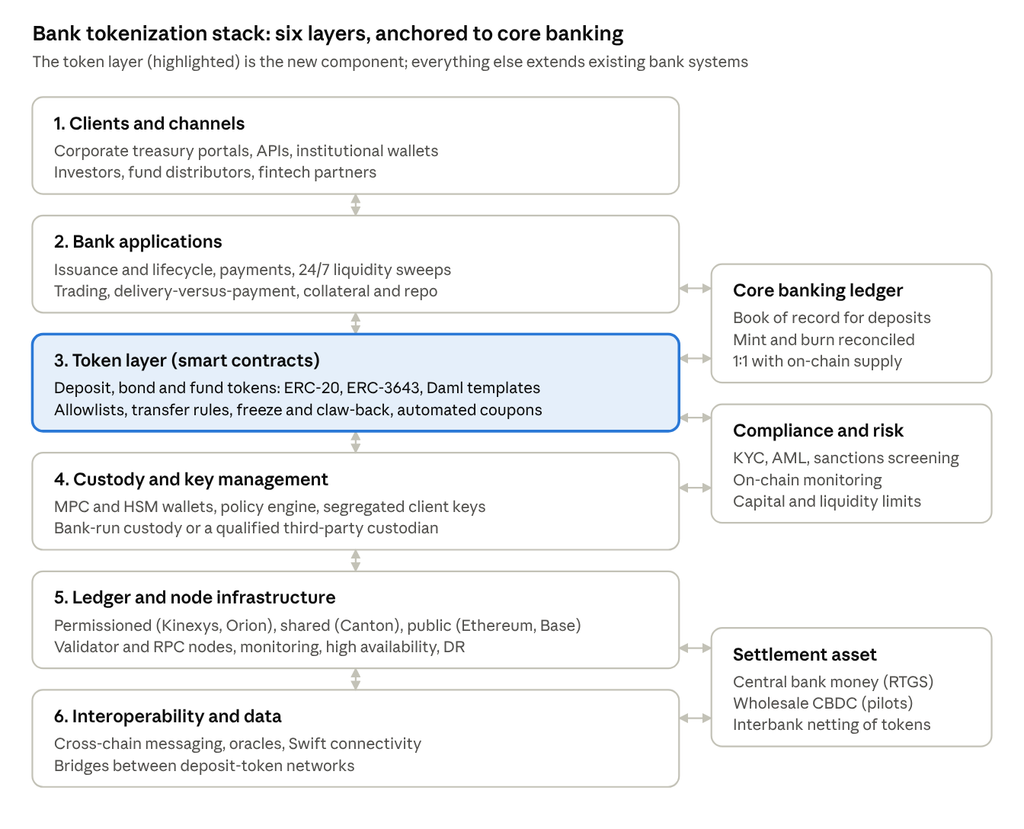
Read it top down: client instructions reach bank applications, which mint, move and burn tokens through smart contracts; keys in custody sign transactions that settle on the ledger. On the right, core banking stays the book of record, compliance screens every flow, and interbank settlement happens in central bank money.
| Network model | Examples | Strengths | Trade-offs |
|---|---|---|---|
| Private permissioned | Kinexys, Citi Token Services, HSBC Orion | Full control, privacy, known validators | Closed loop; limited reach and interoperability |
| Shared institutional | Canton Network, Partior, The Clearing House network (planned) | Multi-bank settlement with privacy | Governance and onboarding take time |
| Public with permissioned tokens | JPMD on Base; SG-FORGE on Ethereum | Global reach, DeFi composability, open tooling | Privacy and capital treatment under Basel SCO60 |
Most banks now pursue a hybrid: permissioned tokens, allowlisted wallets, and deployment on more than one network. That makes reliable node operations, monitoring and cross-chain connectivity a core infrastructure decision.
Is bank tokenization regulated? The 2026 regulatory map
Yes. Bank tokenization sits inside existing banking, securities and payments law, with new rules for stablecoins layered on top. The big 2026 change is clarity: US regulators now treat a tokenized deposit as a deposit, and the OCC finalized its GENIUS Act stablecoin rule on 21 October 2026, effective 18 January 2027 (Goodwin).
| Jurisdiction | Key framework | What it means for banks | Status (Nov 2026) |
|---|---|---|---|
| United States | GENIUS Act; OCC 12 CFR Part 15; FDIC proposals | Tokenized deposits are excluded from “payment stablecoin”; banks may issue stablecoins via OCC-approved subsidiaries | OCC final rule adopted (OCC Bulletin 2026-50); FDIC rules on tokenized deposit records proposed (Paul Hastings) |
| European Union | MiCA; DLT Pilot Regime | Bank-issued e-money tokens (e.g. EURCV) licensed under MiCA; tokenized securities trade under the DLT Pilot | MiCA fully applicable since 30 Dec 2024; DLT Pilot live since 23 Mar 2023 and under review (ICMA) |
| United Kingdom | Digital Securities Sandbox; regulated liability network pilot | Live testing of digital bonds and tokenized sterling deposits | HSBC Orion passed Gate 2 (Jul 2026); first digital gilt (DIGIT) due by Q1 2027 |
| Singapore | MAS Project Guardian | 40+ financial institutions, associations and policymakers across seven jurisdictions piloting tokenized funds, bonds, FX and deposits | Pilots ongoing; Global Layer One infrastructure in development (PDP Spectra) |
| Hong Kong | HKMA Project Ensemble (EnsembleTX); Stablecoins Ordinance | Real-value tokenized deposit and MMF settlement; 24/7 tokenized central bank money planned | Pilot running through 2026 (HKMA) |
| Global | Basel SCO60 cryptoasset standard | Sets capital treatment for banks’ cryptoasset exposures, including tokenized traditional assets; industry groups say it penalizes assets on permissionless chains | In force from 1 Jan 2026; targeted review under way (BIS) |
Watch the Basel review closely. Industry groups argue that SCO60 penalizes tokenized assets on public blockchains, and its outcome will shape which networks banks can use economically.
What are the risks of tokenization for banks?
The biggest risks are fragmentation, liquidity run speed, legal certainty and operational security, not the technology itself. Each has a known mitigation.
| Risk | Why it matters | Mitigation |
|---|---|---|
| Network fragmentation | A deposit token on one network cannot settle against another bank’s token elsewhere (Cosmos) | Join shared networks; use interoperability standards and bridges vetted by the bank |
| Faster deposit outflows | 24/7 transferable money can leave faster, affecting maturity transformation (Paul Hastings) | Higher liquid-asset buffers; intraday liquidity monitoring; transfer limits |
| Thin secondary liquidity | A token with no secondary venue is no more liquid than the original asset (PDP Spectra) | Start with cash and MMFs; connect to venues and repo markets |
| Legal and settlement finality | Courts must recognize the token as the asset and the on-chain transfer as final | Legal opinions per jurisdiction; digital-native issuance; DLT-recognizing law |
| Smart contract and key risk | Code bugs or lost keys can freeze or lose assets | Audits, formal verification, MPC or HSM custody, kill switches |
| Compliance on public chains | Tokens can reach unknown wallets | Permissioned tokens on public chains: KYC-bound allowlists, freeze and claw-back |
| Capital treatment | Basel SCO60 may raise capital for public-chain assets | Track the Basel review; favor eligible structures |
| Vendor concentration | Few platforms dominate (e.g. BNY and GS DAP for tokenized MMFs) (Crypto Briefing) | Multi-vendor architecture; exit plans |
| Privacy | Public ledgers expose positions and flows | Privacy-enabled networks (e.g. Canton), zero-knowledge proofs, permissioned subnets |
How should a bank implement tokenization? A four-phase roadmap
Start narrow with one high-value use case, usually a deposit token for treasury or a tokenized money market fund, prove it internally, then launch to clients and connect to shared networks. A bank on a managed platform can reach client production in about 12 to 18 months.
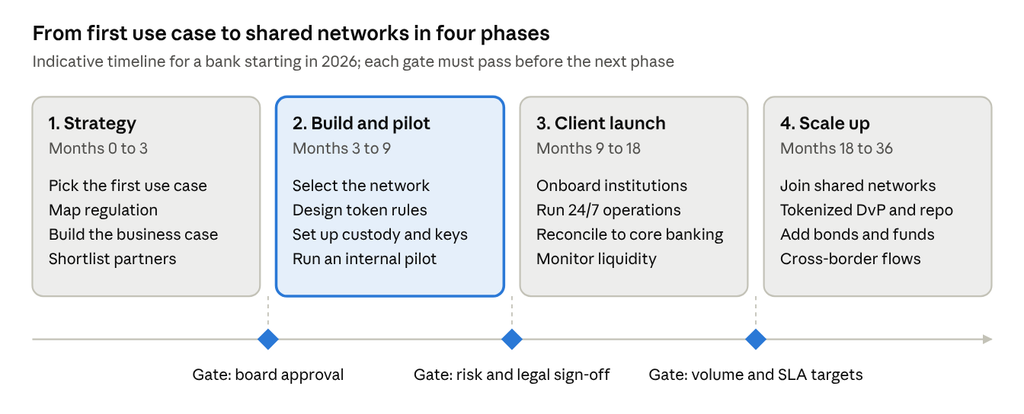
The pilot phase (highlighted) is where most programs stall, so set its exit criteria before it starts.
Questions to settle before phase 2:
- Which balance or asset moves first, and what pain does it remove for which client?
- Deposit token, stablecoin subsidiary, or both?
- Private, shared or public network, and how will it connect to the networks peers are joining?
- Who runs custody, keys and node infrastructure: the bank, or a regulated partner?
- How does the token reconcile to the core banking ledger, and who owns breaks?
- What capital treatment applies under your regulator’s version of Basel SCO60?
What is the future of tokenization in banking?
The next phase is network effects, not more pilots. Through 2027 expect shared deposit-token networks in the US (The Clearing House), the UK (regulated liability network) and across borders (Agorá), tokenized MMFs used as collateral, and atomic DvP between tokenized securities and tokenized cash. Banks that ship a deposit token and connect to at least one shared network in 2026–27 will set the standards others follow.
Frequently asked questions
What is tokenization in banking?
Tokenization in banking is the issuance of a bank asset or liability, such as a deposit, bond or fund share, as a digital token on a programmable ledger. The bank keeps the legal obligation; the token enables 24/7 transfer, instant settlement and automated rules.
What is a tokenized deposit?
A tokenized deposit is a commercial bank deposit recorded and transferred as a token on a blockchain. It remains a deposit of the issuing bank, can pay interest and, under a 2026 FDIC proposal, is treated in the US like any other deposit. JPMorgan’s JPMD is a leading example.
Is a tokenized deposit the same as a stablecoin?
No. A tokenized deposit is a bank’s own liability backed by its balance sheet. A stablecoin is a claim on a separate pool of reserve assets, held by an issuer that cannot lend those reserves. The US GENIUS Act explicitly excludes tokenized deposits from the stablecoin definition.
Which banks use tokenization today?
JPMorgan (Kinexys), Citi (Citi Token Services), HSBC (Orion and its Tokenised Deposit Service), BNY, Goldman Sachs (GS DAP), Société Générale (SG-FORGE) and DBS run tokenization in production in 2026. Deutsche Bank and dozens of others take part in BIS Project Agorá.
How big is the tokenized asset market?
About $39 billion in distributed on-chain real-world assets, excluding stablecoins, in October 2026 according to rwa.xyz, plus roughly $352 billion represented on mostly permissioned ledgers. On that measure the market is roughly six times its January 2025 level; trackers using other methods report different totals. Long-range forecasts range from $16 trillion (BCG, 2030) to $30 trillion (Standard Chartered, 2034).
Do banks use public or private blockchains for tokenization?
Both. Most began on permissioned ledgers such as Kinexys and HSBC Orion. Since 2025 the trend is permissioned tokens on public or shared networks: JPMD runs on Base, and Goldman, HSBC and Société Générale use the Canton Network.
What are the main benefits of tokenization for banks?
Faster and atomic settlement, 24/7 liquidity and treasury movement, mobile collateral, lower reconciliation cost, cheaper cross-border payments, programmable money, and new revenue from issuance, custody and distribution of tokenized products.
How long does it take a bank to launch tokenization?
A focused pilot, typically a deposit token or tokenized MMF for internal or institutional use, can run within six to twelve months on a managed platform. Production with external clients and network connections usually takes 12 to 24 months, mostly for legal, risk and integration work.
Disclaimer
This article is for general information and education only. It is not legal, regulatory, tax, accounting, investment or financial advice, and it is not an offer or recommendation to buy, sell or use any product, token or service.
Facts and figures were checked against the linked sources as of 5 November 2026. Market-size figures come from third-party trackers whose methods differ and change over time. Forecasts are third-party estimates, not predictions by the author. Implementation timelines and maturity ratings are the author’s indicative assessments. Regulation of tokenized deposits, stablecoins and digital securities is evolving and varies by jurisdiction, so details may have changed since publication.
Naming a bank, platform or project does not imply endorsement or partnership, and all trademarks belong to their owners. Readers should verify current information with primary sources and consult qualified legal, compliance and financial advisers before making decisions.
Blockiance is a Leading Web3, AI, and Crypto news with real journalism on the latest trends shaping the future of tech.